- info@sknncdalliance.com


UN High-Level Meeting on NCDs: Call to Action for SKN
The UN High-Level Meeting on Non-Communicable Diseases (NCDs) will take place in September 2025 and the St. Kitts and Nevis NCD Alliance believes that this provides all those in the Federation who are working on NCDs with a unique opportunity to influence the global approach to NCDs. As such, we encourage all stakeholders to assess the progress we are making in the Federation to tackle NCDs and ensure that our policies, programmes and interventions are effective, evidence-based and progressing in a timely manner so that our country’s delegation to this meeting can share our progress and learnings, and advocate for global action. The decisions made at the UN High-Level Meeting on NCDs have the potential to affect us all and we should, therefore, contribute to this global dialogue.
Global NCD Priorities
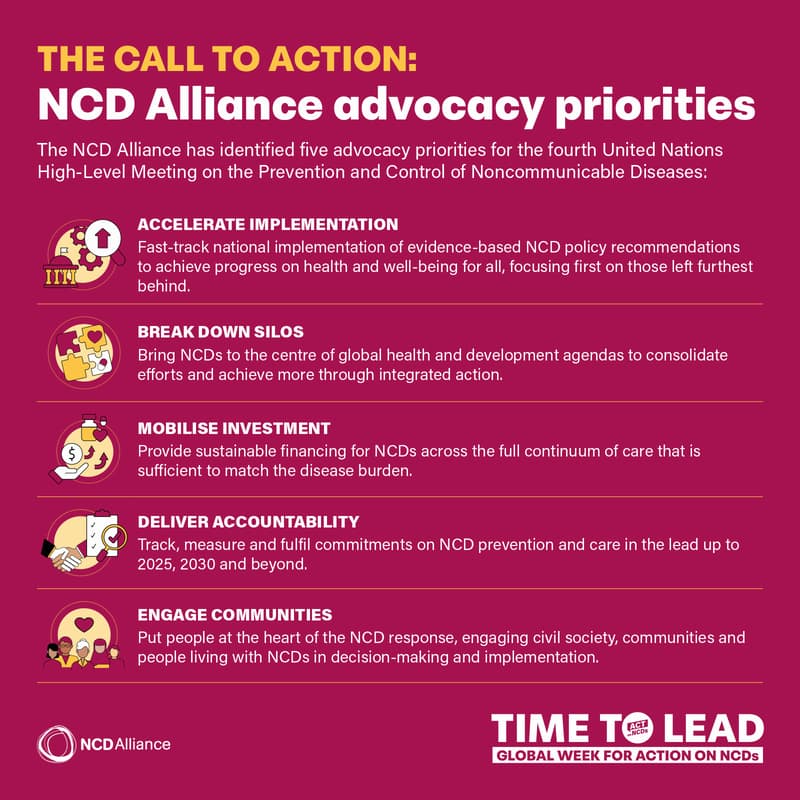
We stand with the NCD Alliance and support their global priorities for the UN High-Level Meeting. These priorities can be accessed here. In summary these are:
- ACCELERATE IMPLEMENTATION: Fast-track national implementation of evidence-based NCD policy recommendations to achieve progress on health and well-being for all, focusing first on those left furthest behind.
- BREAK DOWN SILOES: Bring NCDs to the centre of global health and development agendas to consolidate efforts and achieve more through integrated action.
- MOBILISE INVESTMENT: Provide sustainable financing for NCD across the full continuum of care that is sufficient to match the disease burden.
- DELIVER ACCOUNTABILITY: Track, measure and fulfil commitments on NCD prevention and care in the lead up to 2025, 2030 and beyond.
- ENGAGE COMMUNITIES: Put people at the heart of the NCD response, supporting civil society, communities and people living with NCDs to be advocates, engage with policy makers, and occupy key decision-making roles.
o.
Regional NCD Priorities
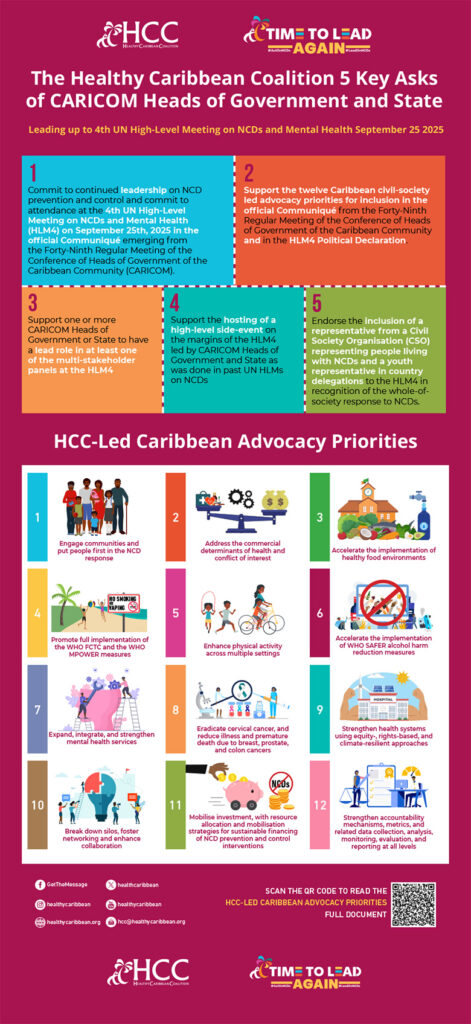
We also support the Healthy Caribbean Coalition, the Caribbean’s regional NCD Alliance, and its regional priorities, which can be accessed here and are summarised below.
- Engage communities and put people first in the NCD response by
- Developing mechanisms for meaningful engagement and involvement of people living with NCDs, people living with disabilities, young people and other people and groups in situations of vulnerability
- Investing in civil society
- Enhancing health literacy and public education
- Address the commercial determinants of health and conflict of interest by strengthening NCD and public health governance systems to tackle policy interference by commercial actors.
- Accelerate the implementation of healthy food environments by introducing healthy food policies.
- Promote the full implementation of the WHO FCTC and the WHO MPOWER measure by appropriately regulating tobacco, nicotine and related novel and emerging products.
- Enhance physical activity across multiple settings including schools, workplaces and communities
- Accelerate the implementation of the WHO SAFER alcohol harm reduction measures.
- Expand, integrate and strengthen mental health services
- Eradicate cervical cancer, and reduce illness and premature death due to breast, prostate and colon cancer by enhancing strategies for the elimination of cervical cancer and implementing risk reduction measures and evidence-based screening and treatment guidelines for breast, prostate and colon cancer.
- Strengthen healthy systems using equity-, rights-based and climate-resilient approaches.
- Break down silos, foster networking and enhance collaboration.
- Mobilise investment, with resource allocation and mobilisation strategies for sustainable financing of NCD prevention and control interventions.
- Strengthen accountability mechanisms, metrics and related data collection, analysis, monitoring, evaluation and reporting at all levels.
.
Local Call to Action
Based on the above global and regional priorities, as well as our call to assess the progress we are making in the Federation, the St Kitts and Nevis NCD Alliance urges our nation to take action. We call on the Federation to prioritise the following key issues:
Creating a Healthy Food Environment
- Finalise and accelerate the implementation of the federal sugar-sweetened beverage (SSB) policy.
- Develop and implement a federal school nutrition policy which addresses the following
- Mandatory Guidelines – Establish national standards for school meals and snacks to promote balanced nutrition and prevent diet-related diseases.
- SSB and Ultra-Processed Food Restrictions
- Prohibit the sale and promotion of sugar-sweetened beverages and ultra-processed foods in and around schools.
- Education & Capacity Building – Integrate nutrition education into the curriculum and train school staff to promote healthy eating habits.
- Revisit front-of-package warning labels and develop a national strategy for implementation.
- Begin developing legislation to restrict and ban industrially produced trans fats.
- Continue the process of developing a salt reduction strategy
- Continue efforts to support local agriculture to ensure that healthy foods are accessible and affordable.
- Develop and implement effective alcohol reduction policies by implementing the WHO’s SAFER interventions
Promoting Good Mental Health
- Continue working with the Taiwan ICDF and other key stakeholders to strengthen mental health care and support services to ensure accessibility for all, with a focus on reaching men.
- Develop programmes that promote positive mental health among young people, particularly young men.
.
Mobilising Finance for NCDs
- Allocate funding to develop and fully implement an NCD Strategy and Action Plan
- Invest more funding in primary and community-based care, public health campaigns, and school-based health initiatives.
- Adequately fund the SKN Moves programme so that it can reach more of the public with important messages about healthy eating, physical activity and age-appropriate health checks.
- Ensure that there is adequate funding to ensure that basic NCD medications, diagnostics and treatments are easily accessible by the public at health centres and hospitals
Strengthening Health Systems
- Continue strengthening healthcare systems by building the capacity of healthcare professionals, procuring relevant equipment, and improving infrastructure.
- Continue efforts to progress the development of the new climate-smart JNF Hospital and further the concept of both a climate-smart, technologically smart health network across St. Kitts and Nevis.
- Ensure all health facilities are fully accessible to persons with disabilities.
- Invest in equipment for disabled patient transfer during emergencies.
- Ensure accessible healthcare facilities, services, and information for individuals with disabilities. This includes physical access for those with mobility challenges, sign language interpretation and support for those with visual disabilities.
- Ensure public facilities can physically accommodate persons with disabilities i.e. wheelchair accessible restrooms, ramps into public buildings, parking spaces close to buildings, etc.
- Create health communication materials in various formats, including braille, large print, and easy-to-read versions, as well as audio and video content with captions available in multiple commonly spoken languages and sign language interpretation
- Ensure affordable and easy access to health insurance for individuals with disabilities.
- Accelerate the implementation of Universal Health Coverage.
- Allocate funding to begin the implementation of UHC
- Prioritise Essential Health Services for NCDs Under UHC
- Ensure that NCD prevention, diagnosis, treatment, and rehabilitation are covered under UHC.
- Include chronic disease medications (e.g., for diabetes, hypertension, and cancer) in the essential medicines list covered under UHC.
- Ensure that those considered to be most vulnerable in our community, especially those who are unable to access private health insurance, can access essential health services through UHC. Particular groups to focus on include persons with disabilities, persons on a low income, the elderly and other such groups.
- Reduce Financial Barriers to Healthcare Access Through UHC
- Implement co-payment caps or subsidies for low-income and vulnerable groups.
- Reduce or eliminate out-of-pocket payments for essential NCD services.
- Ensure affordable access to diagnostic services (e.g., MRIs, blood tests, and specialist consultations).
Promoting Equitable Access to Medicines and Health Products
- Ensure medicines and health products are affordable so that everyone can access the treatments they need to manage their NCDs. The WHO recommends the following minimum lists
- For medication: at least aspirin, a statin, an angiotensin converting enzyme inhibitor, thiazide diuretic, a long-acting calcium channel blocker, metformin, insulin, a bronchodilator and a steroid inhalant.
- Technologies – at least a blood pressure measurement device, a weighing scale, blood sugar and blood cholesterol measurement devices with strips and urine strips for albumin assay.
Tackling the Stigma Associated with NCDs
- Develop an empowering and informative NCD education programme that also addresses stigma. This programme should be inclusive, targeting the elderly, young people, men and women, persons with disabilities, the LGBTQ+ community, incarcerated individuals, and religious communities. This programme should be developed by the Health Promotion Unit either as part of their SKN Moves programme or a separate initiative. It should also be collaborative, with the Health Promotion Unit working alongside relevant government departments such as the Ministry of Social Development and Gender Affairs, the Ministry of Youth Empowerment, Ageing and Disability, the Department of Sports, and the Ministry of Education, and should also include civil society, especially those focused on the prevention and control of NCDs, and people living with NCDs.
- Work more closely with people living with NCDs to tackle stigma and to raise awareness. This could involve developing a formal mechanism for people living with NCDs to contribute to the decision-making and policy-making process.
.
Recognise and Address the Link Between Climate Change and NCDs
- The Ministry of Health and the Department of Environment should collaborate to raise awareness of the link between climate change and NCDs and ensure policy coherence between environmental and NCD policies. This includes ensuring climate considerations are in the Federation’s NCD Strategy and Action Plan and that health is a priority in our Federation’s national climate plan. Some areas to consider:
- Develop a strategy to protect those living with NCDs from health shocks that are climate-related (e.g. hurricanes, earthquakes, heat, water shortages, etc.
- Support well-designed climate mitigation measures that also serve to reduce NCD risk factors.
Managing Conflict of Interest
- The Ministry of Health should develop and implement policies to prevent conflicts of interest, ensuring that the alcohol, tobacco, SSB, and unhealthy food industries do not influence NCD policies to the detriment of public health.
- Ensure all ministries align with the Ministry of Health’s mandate to improve the nation’s health and are not compromised by the interests of industries producing unhealthy commodities (alcohol, tobacco, fossil fuels, SSBs, and unhealthy foods).
- Ministries must prioritise policies, legislation and activities that promote health rather than harm it.
Advancing Regional Health Integration
- Collaborate with other OECS countries to develop a regional NCD healthcare system, reducing the need for patients to travel far for care.
- Support the establishment of centres of excellence throughout the OECS so that high-quality, affordable care can be easily accessed in the region and ensure that the new JNF Climate-Smart Hospital becomes one of those centres of excellence.
We call on all stakeholders, especially the government, to accelerate efforts to prevent and control NCDs and ensure a healthier future for all.
ABOUT US
The St Kitts and Nevis NCD Alliance is a coalition of civil society organisations focused on the prevention and control of NCDs through public education, supporting NCD patients, advocating for evidence-based NCD policies and building the capacity of our members.
Add Your Heading Text Here
CONTACT DETAILS
Contact details: 1 869 765 8702 (WhatsApp)
Email address: ncdallianceskn@gmail.com
Email address: ncdallianceskn@gmail.com